
All About Plaice: Denmark’s Favourite Flatfish

A Deep Dive into Plaice
Here at Fiskerikajen Update, we love sharing our enthusiasm for the sea and all the incredible creatures that live beneath the surface.
Over the years, we’ve dedicated features to many of the species we have the privilege of selling, but somehow we’ve never taken a proper look at the wonderful plaice. Which is actually a little strange.
Perhaps it’s because plaice is such a given in Danish fisheries. It’s one of the cornerstones, one of the constants – even if it’s a constant that is always moving and changing.
Whatever the reason, it’s time to fix that.
So here comes a deep dive into the wonderful plaice.
Plaice – One of the Biggest Stars of Danish Fisheries
As mentioned, it’s impossible to talk about Danish fishing without talking about plaice.
It’s one of “The Big Three”: herring, cod and plaice – in that order. And there’s certainly no shame in coming after herring and cod in a ranking like that, which gives plaice an honourable and highly significant third place.
Identifying a Plaice
The plaice’s Latin name is Pleuronectes platessa, which roughly translates to “flat, side-swimming fish” – a fairly accurate description.
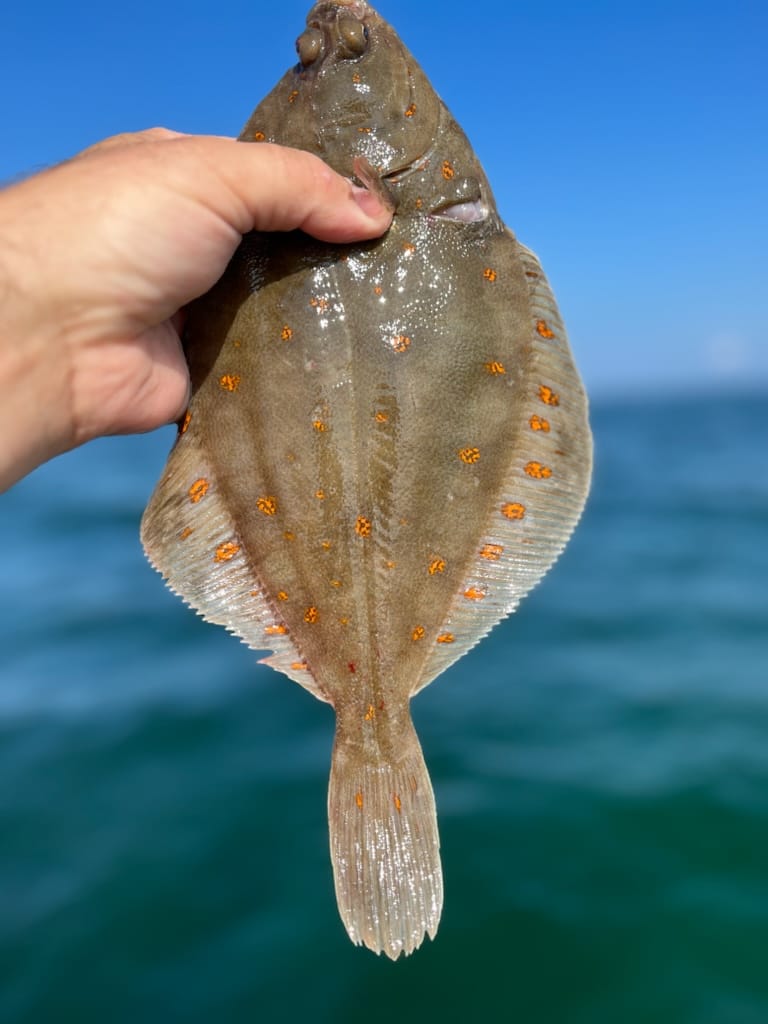
Plaice are right-sided flatfish, meaning that both eyes are located on the right-hand side of the body. Just behind the eyes is a row of bony knobs, and these are actually the feature you should look for if you're trying to distinguish a plaice from similar species.
Plaice are also known to hybridise with both flounder and dab, which can make identification tricky. But if the fish has those characteristic four to eight bony knobs behind the eyes, it’s almost certainly a true plaice.
Distribution and Historical Importance
Plaice are widely distributed and can be found throughout much of the northeastern Atlantic, from northern Morocco all the way to southern Greenland.
The largest concentrations are found in the southern North Sea, stretching from the English Channel through Belgian, Dutch and German waters, across Dogger Bank and along the Danish coastline.
For that reason, plaice has always been an important part of European fisheries and has been enjoyed for as long as people have been catching fish.
One particularly useful characteristic of plaice is that it can be dried with very little salt. Before refrigeration, this made it possible to store plaice for long periods. The resulting product was known as stockfish, and to this day stockfish and a cold beer remain a rather excellent combination.
Life Cycle, Spawning and Life on the Seabed
Plaice can be found from just one metre of water down to around 100 metres, although they occasionally occur even deeper.
Females reach sexual maturity between three and six years of age, while males mature slightly earlier, between two and four years.
Spawning takes place at depths of 20–40 metres between November and April, depending on location. In the North Sea, plaice spawn from January to April in the southern and central regions as well as east of England and Scotland. In the Kattegat, spawning occurs from late February to early March, primarily in the southern areas and along the Swedish coast.
Depending on size, a female may release up to 500,000 pelagic eggs.
After spawning, the eggs and larvae drift with the currents towards coastal nursery grounds. After one to two months, the larvae begin one of nature’s more remarkable transformations. One eye migrates across the head and the fish begins swimming with its left side facing downward.
At this point, the young plaice has become a true flatfish, perfectly adapted to life on soft seabeds such as sand, gravel and mud.
Plaice are masters of camouflage and adjust their colouring to match the seabed beneath them. As a result, living plaice can vary enormously in appearance, while dead fish tend to look much more alike.
Plaice are not particularly picky eaters. They feed on all manner of small creatures that fit into their mouths, including worms, snails and juvenile shellfish.
Because they follow their food sources, large plaice can sometimes be found surprisingly close to shore, even though the biggest fish are more commonly caught in deeper waters.
Giant Plaice, Old Fish and Danish Relocation Projects
Most large plaice are remarkably old.
In fact, they can live for up to 50 years, although such veterans are rare. They can also grow surprisingly large, even if most still fit comfortably into a frying pan.
In 2023, we received a plaice weighing 4 kilos at Fiskerikajen – and that was its gutted weight. While that is an impressive fish, specimens of around 7 kilos have been recorded, and that requires one serious frying pan.
Historically, plaice fishing was enormously profitable. Because plaice abundance varied greatly between regions, Danish fisheries began relocating live plaice from areas with strong populations to areas with weaker populations as early as the beginning of the twentieth century.
These relocation programmes became known as “transplantations”.
At their peak in the 1960s, no less than 310 tonnes of plaice were moved around Danish waters.
It’s remarkable to think about how important fishing once was to the Danish economy. Back then, significant effort and resources were invested in maintaining healthy fish stocks. If some of that commitment returned today, we might well see more fish in Danish waters once again.
And yes, by commitment we also mean money.
How Is the Plaice Population Doing Today?
In recent years, plaice fishing has not been particularly strong.
That said, this sort of fluctuation is actually quite normal for plaice. One fisherman once told us that plaice have seven good years followed by seven bad years.
If there’s any truth in that, we may be approaching the good years once again.
According to ICES, which we frequently refer to here at Fiskerikajen Update, there are a great many plaice on the way. In fact, surveys indicate that there are currently more young plaice in Danish inner waters than at any time since 1999.
The fish are still relatively small, so we’ll need a little patience before they fully enter the fishery.
But it is certainly encouraging news.
Time to Put Plaice on the Menu
So now it’s time to get plaice onto the menu.
We can’t promise that plaice will be cheap this year, but we can confidently say that there will be plenty of beautiful fish available from now until the end of September.
By Christmas, when plaice traditionally appear on many menus, they’ll be every bit as disappointing as they usually are.
Long live the plaice!
Want to know more?
Contact us to get set up with with the season’s best fish and shellfish.

Podcast: Fiskerikajen Update
You can also catch our regular seasonal updates as a podcast.Listen here
