
Gently caught cod in season: how to keep the board sharp and your conscience clear
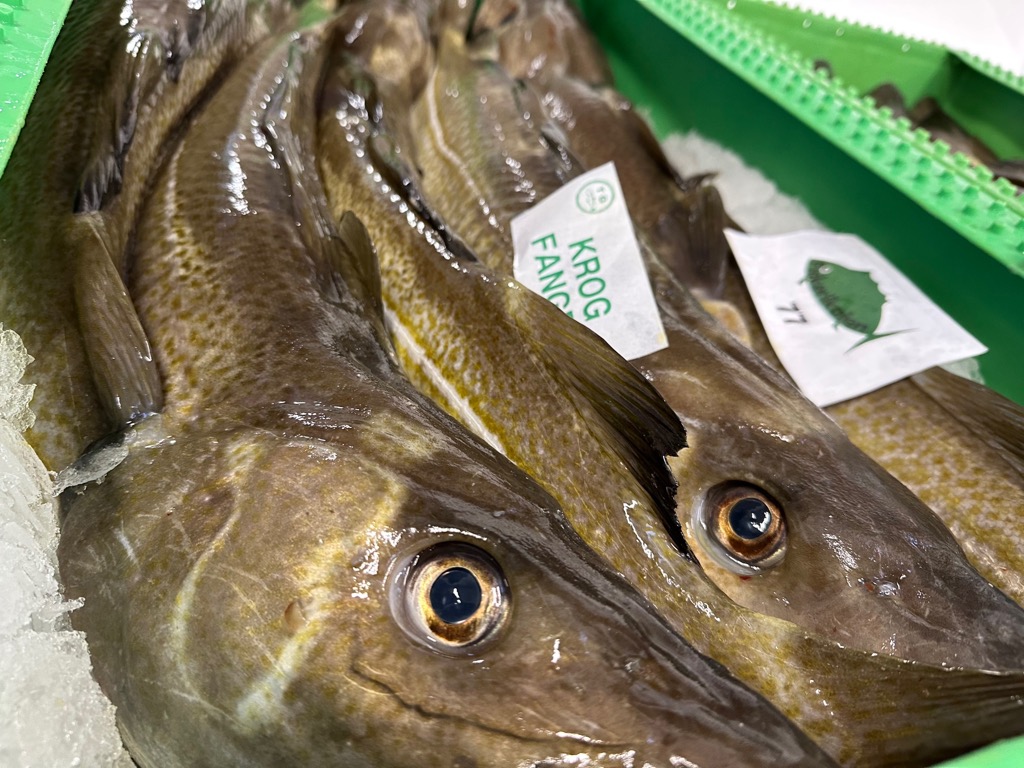

Ah yes, the lovely cod. It’s not so easy being the lovely cod anymore. An ICES quota recommendation of zero and an implemented quota cut of a full 44% for cod in the Skagerrak and the North Sea mean that Danish fishers will land less cod in 2026 than they did in 2025. But is it really all bad news for cod?
That’s what we want to get a bit wiser about, so we can help you make informed choices when you’re putting fish on the menu. After all, that’s exactly why we make Fiskerikajen Update and spend time digging into the things we talk about in what must be the world’s nerdiest fishmonger podcast. We want to harvest from the ocean’s ecosystems in the most sensible way possible—and the only way we can do that is if our customers want to do the same.
We’ve already heard from several restaurants that have received unsolicited questions about why they choose to keep cod on the menu. And that’s obviously frustrating. Why shouldn’t you be allowed to serve a fish that is legal to catch—especially when the cod on your menu is caught using low-impact methods?
The answer is YES, of course you can. And you are absolutely doing the right thing when you choose fish that are gently caught and in season. And cod is very much in season!
A bit about low-impact fishing
Low-impact fishing is selective and targeted at mid-sized fish. This leaves room for smaller fish to grow large enough to spawn, while allowing the bigger fish and experienced spawners to keep swimming. That’s the kind of fishery we support—and always will. It’s a fishery deeply embedded in the coastal communities along Denmark’s shores, and the few that remain deserve our protection.
Still, it becomes problematic when informed choices made by chefs and restaurants are questioned—because are those asking the questions equally informed? In many cases, the answer is no. The renewed attention many Danes have given the ocean in recent years is, in general, a very good and important development. The ocean desperately needs it, after having been ignored for millennia.
But it’s important to remember that every time we eat, there is a cost to nature. Sometimes large, sometimes minimal. That’s exactly why it matters so much how our food is produced or harvested. Has the person questioning cod on the menu considered where the rest of their ingredients come from? If you eat strictly vegan, organic, and biodynamic, then sure—you can take shots at anything. But for everyone else who eats farmed animals, drinks milk, and so on, there are far bigger issues to focus on long before gently caught cod.
Unfortunately, cod are less abundant now than they have been historically. That said, there are more cod in the North Sea and Skagerrak today than there were, for example, in the mid-2000s. During the 2010s, the cod stock increased again, and now it is declining. This pattern has repeated itself since the early 1990s. And although the stock is currently vulnerable, we expect it to recover again—and so does ICES, at least in the northern part of the North Sea and the Skagerrak.
Would it be great if there were more cod? Hell yes—and no one wants that more than we do. But how do we get more cod back? By starting to treat the ocean as the ecosystem it actually is. We know that large, contiguous areas that are fully protected from fishing regenerate far faster than any protected areas on land. After just a few years, we see dramatically higher levels of life in these protected zones—and one of the biggest game changers is how quickly that life spreads into surrounding areas.
Pressure on marine life
There are many pressure factors affecting life in the ocean, and most of them are human-made. Pollutants, excessive nutrient runoff, raw material extraction—where entire reef structures are still being ripped up to build motorways—temperature rises due to climate change, just to name a few. And then there’s the most obvious one: fishing. Anyone can see that there are fewer fish in the sea when a fisher lands a catch. But far fewer people think about the fact that the motorway they’re driving on is built from stones that once made up the Jyske Reef—now just a shadow of its former self.
So does that mean we should stop harvesting from the ocean? The answer is an unequivocal NO!!
Let us say it again… 79% of the planet is covered by water. 98% of the habitable biosphere exists in the ocean. Sure, there are no insects or birds laying eggs in the air—but even 11 kilometres down, in the deepest parts of the ocean, there is life. So the answer to whether we should continue eating from the ocean is an obvious YES!
The question, then, is how we harvest from the ocean as an ecosystem. And here it’s crucial to remember that destructive fishing methods like bottom trawling—and even beam trawling—are still legal and treated as equal to the most low-impact fishing methods. Only very few places in the world prioritise gentle fisheries over destructive bottom-towed gear, despite the fact that these areas—without exception—see more life after bottom trawling is restricted than before.
In Denmark, new trawl-free areas have been agreed upon, but they are not expected to be fully implemented for another two years. That means bottom-towed gear is still being used in these areas right now. Stupid? Yes. Will these areas be teeming with life in a few years? That depends on whether we address the many other pressure factors—but at least there is a chance. And without them, there wouldn’t be.
The unique Øresund
This is where we need to remember the completely unique area right outside our own front door, where bottom trawling has been banned since 1932: the Øresund. In the Øresund, the cod stock has been increasing year after year, creating a spillover effect of cod larvae and marine life into surrounding areas that are still under heavy pressure from the many factors mentioned above. And this is happening even in the Øresund, where massive amounts of dredged material are currently being dumped to build Lynetteholmen—and despite intense pressure from thousands of cormorants along the Danish and Swedish coasts, particularly around Saltholm and Peberholmen.
Even with all these challenges, the cod stock is growing. The only real difference? The seabed is not being trawled. That means the bottom is alive—allowing plants and benthic organisms to live, produce food, and create shelter for fish in the Øresund.
Choosing not to put cod from low-impact, selective fisheries on the menu simply doesn’t make sense. These fisheries—targeting mid-sized fish of the highest quality—should be the only ones allowed, and they should play a much bigger role in shaping the future of fishing. Unfortunately, that’s not how things work today. Bottom-trawl fisheries cannot avoid catching cod, so even if a zero quota were implemented, large amounts of cod would still be caught—just discarded, turned into fishmeal, or destroyed. The only people punished would be the fishers who rely on catching cod, not those using destructive bottom-towed gear.
So hold on to cod. Keep it on the menu—but make an agreement with us about which other fish should take its place if we can’t source gently caught cod. There are plenty of wonderful alternatives available during these beautifully cold winter months.
Want to know more?
Contact us to get set up with with the season’s best fish and shellfish.

Podcast: Fiskerikajen Update
You can also catch our regular seasonal updates as a podcast.Listen here
